Showing posts with label fraternal mug. Show all posts

Friday, November 14, 2014

Fraternal Shaving Mugs: Independent Order of Odd Fellows


NOTE: ALL OF THESE MUGS ARE FOR SALE ON EBAY 
CLICK ON EBAY LINK BENEATH EACH IMAGE


The Independent Order of Odd Fellows is one of the oldest and largest fraternal organizations in the world. It is one of the most common types of fraternal shaving mugs. There are a great variety of Odd Fellows mugs representing the many different walks of life that make up their membership.  The common characteristic of all of them are the Three Links logo, usually (but not always) with the letters F., L. and T., standing for Friendship, Love and Truth, in the center. Other common design elements are taken from the more esoteric aspects of the Odd Fellows: the all-seeing eye, the ceremonial tent and crossed swords or staves.

In Fraternally Yours by Bernie Lucko, he speculates that "the origin of the name Odd Fellows dates to 55 A.D. Soldiers of the Jewish legion of the Roman Army, during the reign of Nero, were known for their singular camaraderie and an uncanny ability to recognize each other by signs after night. Titus  Caesar  called  them  Odd Fellows." However, official Odd Fellow sources claim that "the altruistic and friendly society came to be known as "Odd Fellows" because it was odd to find people organized for the purpose of giving aid to those in need and of pursuing projects for the benefit of all mankind." Personally, I like Bernie's origin better. There is a certain mysteriousness to it. The official version sounds a bit apocryphal, however nobel its intentions.


Above is a short video about the Odd Fellows, produced by the Odd Fellows. I found it informative and entertaining for the most part. There are several instances that I would take with a grain of salt. But there is no denying that the Odd Fellows have done good things for a great number of people and communities.


Rare Double Fraternal - IOOF and IORM


Rare Double Fraternal - IOOF and IORM


Rare Double Fraternal - IOOF and IORM


From the Sovereign Grand Lodge Independent Order of Odd Fellows:

"In 17th Century England, people were facing a lot of challenges. Life was tough, often lawless and desperate. Medicine was still crude and in a primitive stage. Life expectancy was about 45 to 50. There were lots of sickness, orphaned kids, widowed mothers and many people cannot afford to pay a decent burial for the dead.  
So, ordinary people from different trades and walks of life found it necessary to group together as brothers and sisters and contribute some of their hard-earned wages to a common fund which they could use for unfortunate times such as sickness, losing a job and even death. They would work together to help each other and the unfortunate families back on their feet, whether it was rebuilding a barn that had burned or putting in a new crop after a devastating season. 
Such altruistic and friendly society came to be known as "Odd Fellows" because it was odd to find people organized for the purpose of giving aid to those in need and of pursuing projects for the benefit of all mankind. It was believed that they were "an odd bunch of fellows" who would behave in such a selfless and seemingly impractical fashion. Odd Fellows are also known as "The Three Link Fraternity" which stands for Friendship, Love and Truth.  
The Independent Order of Odd Fellows was founded on the North American Continent in Baltimore, Maryland, on April 26, 1819 when Thomas Wildey and four members of the Order from England instituted Washington Lodge No. 1. This lodge received its charter from Manchester Unity of Odd Fellows in England. At that time, the city was suffering both a yellow fever epidemic and mass unemployment so they dedicated the organization to "Visit the sick, relieve the distress, bury the dead and educate the orphans." 
Odd Fellowship became the 1st national fraternity to include both men and women when it adopted the beautiful Rebekah Degree on September 20, 1851. This degree is based on the teachings found in the Holy Bible, and was written by the Honorable Schuyler Colfax who was Vice President of the United States during the period 1868-1873. Odd Fellows and Rebekahs were also the first fraternal organization to establish homes for our senior members and for orphaned children.  
Today, Odd Fellows and Rebekahs continue to exist with nearly 10,000 lodges in approximately 26 countries consisting of men and women who united together for mutual aid and conviviality, providing social and practical support for each other and their communities in every way possible. Even though we have come a long way now, there are still more needs to be done. Working together to achieve these goals and help our fellow men creates a bond that cannot be described – a brotherhood and sisterhood of benevolence that can only be felt as an active participant. Working together, we can really help make a difference!"


From Fraternally Yours by Bernie Lucko:

"In 1745, less than three decades after the founding of the Masonic Order in England, the Ancient and Honorable, Loyal Odd Fellows Was organized in Oakly Arms, Great Britain. It was not until April 26, 1819 in Baltimore, Md., that the society was established in the United States as the Independent Order of Odd Fellows (IOOF). 
They met in Seven Star Tavern until their boisterousness forced them to meet in another place. The IOOF has three initiatory degrees: Friendship, Brotherly Love and Truth. The letters F-L-T are frequently found on IOOF mugs. In 1915 the Odd Fellow Review  claimed  3,418,833  members, gathered largely, though not wholly, from the wage-earning class. 
The official story of the origin of the name Odd Fellows dates to 55 A.D. Soldiers of the Jewish legion of the Roman Army, during the reign of Nero, were known for their singular camaraderie and an uncanny ability to recognize each other by signs after night. Titus  Caesar  called  them  Odd Fellows. It is further reported that Agricola, one of Titus Caesars generals, invaded Wales, spreading these Odd Fellows from Rome to Great Britain. 
Since Freemasons could go on to higher degrees, this pressure lead to the founding of the Encampment Lodge within the IOOF. So, beginning in 1885, there were three additional degrees added: Patriarchal, Golden Rule and Royal Purple. The lodge also bestows a higher honorary degree, the Grand Decoration  of Chivalry, which corresponds to the Masonic 33rd degree. In the past, the IOOF placed considerable emphasis on sickness and death benefits although the lodge has never provided insurance for its members. 
Throughout  the  rituals of many fraternal organizations there was a theme of light and darkness. One of the variations of this symbolic allusion is used by the IOOF as each candidate is received as a man in darkness and in chains. The three-link chain has been adopted as a symbol of unity, brotherhood and good Will. The all-seeing eye is also a symbol associated with several fraternal orders. It has religious significance, symbolizing in all instances a watchfulness over our actions. 
IOOF shaving mugs come in great variations depending on the degrees and rank of members. Every mug, however, has, at a minimum, the three link chain."


Regarding the name the origin of the name, Odd Fellows, there is this on Wikipedia:

Several theories aim to explain the meaning of the name "Odd Fellows". 
One says that they were called "odd" because in the beginning of Odd Fellowship in the 18th century, at the time of industrialization, it was rather odd to find people who followed noble values such as benevolence, charity and fraternalism. 
A variation on that theory states: "The Odd Fellows, at least according to one story, got its curious name from the fact that it was a lodge that opened its doors to the working class who at that time did not ordinarily belong to fraternal orders—and were thus 'odd'. This may or may not be true as the Odd Fellows have been around for a long time and a good many things get lost in the fog of history." 
Another theory states that Odd Fellows were people who engaged in miscellaneous or "odd" trades. In the 18th century, major trades were organized in guilds or other forms of syndicate, but smaller trades did not have any social or financial security. For that reason, people who exercised unusual trades joined together to form a larger group of "odd" fellows. 
A slightly different version of this second theory states: "By the 13th century, the tradesmen's Guilds had become established and prosperous. During the 14th Century, with the growth of trade, the guild 'Masters' moved to protect their power (and wealth) by restricting access to the Guilds. In response, the less experienced (and less wealthy) 'Fellows' set up their own rival Guilds. In smaller towns and villages, there weren't enough Fellows from the same trade to set up a local Guild, so Fellows from a number of trades banded together to form a local Guild of Fellows from an odd assortment of trades. Hence, Guilds of Odd Fellows."


History of the Odd Fellowship in The Three Link Fraternity - Odd Fellowship in California by Don R. Smith and Wayne Roberts:

"Although some books claim to trace Odd Fellowship back to Roman times when members of the Roman Legions in England were called "Fellow Citizens", what is said to be the earliest printed record of an Odd Fellows Lodge appears in a reference to a lodge meeting at a Globe Tavern in England, in 1748. This lodge was numbered nine, so apparently there were at least nine associated Odd Fellows lodges at that time. 
Other evidence suggests that our origins were in an organization known as the Ancient Order of Bucks which thrived in England in the 18th Century, and had as its emblem three bucks with their antlers intertwined. These men had as their leader a "Most Noble Grand" and met in club rooms and taverns. One of their principal emblems was "a bundle of sticks," familiar to modern Odd Fellows as signifying strength in union. They dropped "Bucks" from the name in 1802. Whatever the origin, solid evidence begins to be found in the late 18th Century. By 1796 Odd Fellow organizations were numerous in England, and each was independent from the others. Fraternal groups such as the Odd Fellows were suppressed in England for a time, but by 1803 the Odd Fellows were revived by an organization called "London Union Odd Fellows," which later became known as the "Grand Lodge of England" and assumed authority over all Odd Fellow lodges in that country. 
Victory Lodge in Manchester declared itself independent of the Grand Lodge of England in 1809. In 1814, the six Odd Fellows lodges in the Manchester area met and formed The Manchester Unity of the Independent Order of Odd Fellows, which elected officers and proceeded to standardize degree work of the lodges." [...]
"Among the first records of the Order in America is that of five Brothers of the English Order who met in New York City in 1806, and formed Shakespeare Lodge No. 1.
The founders were three boat builders, a comedian and a vocalist - a group befitting the name "Odd Fellows," indeed. The lodge was self instituted, a common practice in those times.  Their first candidate was a retired actor who was the keeper of the tavern where they met. Accounts state that lodge meetings were accompanied by merry making and mirth, and that the wares of the tavern were freely indulged in. This lodge was dissolved in 1813 due to poor attendance brought on by controversy over the War of 1812.

Another lodge of which little is known existed briefly in New York in 1816. In 1818, Shakespeare Lodge in New York was re-instituted, in the Red Cow tavern, operated by a former member who had in his keeping the books and papers of the former lodge. They claimed to have received a charter from the Manchester Unity which gave them authority over all other Odd Fellows Lodges in the United States, but this authority was not accepted by other lodges. Several more lodges were founded in the New York City area, and one in Philadelphia, due to the efforts of the Brothers of Shakespeare Lodge.

The Independent Order of Odd Fellows as we know it today began in Baltimore, Maryland, where five members of the Order from England founded Washington Lodge No. 1 on April 26,1819, by self-institution. One of these Brothers was Thomas Wildey, the first Noble Grand and the man revered as the founder of Odd Fellowship in North America. A charter was received from Duke of York Lodge in Preston, England, in 1820, a year and a half after its self-institution."

The Old Odd Fellows Building in Bellingham, WA

The Odd Fellows Building in Edison, WA


Wednesday, April 9, 2014

The Improved Order of Red Men Mug: Chas. F. Nolde


This one-of-a-kind shaving mug is painted with a scene around the entirety of the mug. The name "Chas. F. Nolde" is in gilt on the base. The lovely scene, painted with exceptional detail, shows seven indians. In the center, above the name, are four in full headdress sitting around a fire. In the background on a hill, another indian is emerging from a tent, above which is a flag displaying the "TOTE" - Totem Of The Eagle. To the left and right of the central scene are tents, each with an indian in front. Around the handle are two beautiful trees: one coniferous, the other deciduous.


From the Improved Order of Red Men Site:

The fraternity traces its origins back to 1765 and is descended from the Sons of Liberty. These patriots concealed their identities and worked "underground" to help establish freedom and liberty in the early Colonies. They patterned themselves after the great Iroquois Confederacy and its democratic governing body. Their system, with elected representatives to govern tribal councils, had been in existence for several centuries. 
After the War of 1812 the name was changed to the Society of Red Men and in 1834 to the Improved Order of Red Men. They kept the customs and terminology of Native Americans as a basic part of the fraternity. Some of the words and terms may sound strange, but they soon become a familiar part of the language for every member. The Improved Order of Red Men (IORM) is similar in many ways to other major fraternal organizations in the United States.

From http://www.joycetice.com/flaghold/flag004.htm

And what does the T.O.T.E. found on these mean? (Answer: "T.O.T.E.  is a SECRET PASSWORD of the Improved Order of Red Men, known only to members." Yours truly, Regina Jarvis, Admin. Assistant Great Council of the United States, IORM) My published reference says this is "Totem of the Eagle." 


Saturday, October 19, 2013

Fraternal Shaving Mugs: Amalgamated Association of Street and Electrical Railway Employees of America


source

NSMCA


From Fraternally, Yours by Bernie Lucko:

"This was a relatively small but diverse labor organization. In 1944, there were 125,000 members in 435 locals of this union that was headquartered in Detroit, Michigan. By that time, the union included motormen, conductors, guards, brakemen, trolleymen, bus and coach operators, garage men and all men operating cars and trams, all gatemen, watchmen and Wardens, all employees of the car houses and pit department, all collectors, janitors, watchmen, yard crews, elevator men, porters, clerks, trackmen and laborers.  One has to wonder why there are not more mugs depicting this trade with so many jobs included within the union. In addition, individuals who held minor position such as starter, dispatcher, inspector, timekeeper, streetmen or barn shop and track foremen, "working with their fellow workers and not having the power of discipline in the way of hiring, suspending or discharging employees," (that is, non-supervisors) could join the union. 
The union was organized in 1892 in Indianapolis, Indiana and initially represented those working with horse drawn and electric trolley and interurban rail lines. These individuals primarily moved passengers, not freight, and were not directly connected with the interstate railroads that crossed the country during this period of industrial growth. The mug depicts an electric street car with the letters "AA of S & ERE of A" above it."


source

From The Historical Society of Pennsylvania:

The Amalgamated Association of Street and Electric Railway Employees of America (Amalgamated) formed in 1892. Arguing for increased benefits and compensation, Amalgamated organized successful, but occasionally violent, strikes of Philadelphia Rapid Transit Company workers in 1909 and 1910. The union continues today as the Amalgamated Transit Union (ATU).


source


Friday, March 26, 2010

Fraternal Shaving Mugs: Benevolent Protective Order of the Elks | BPOE


From Fraternally Yours by Bernie Lukco:

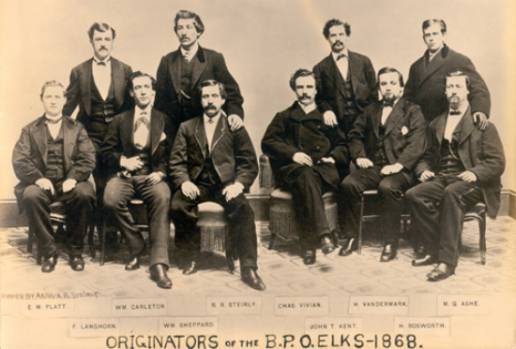
A New York State law that closed saloons and theaters on Sunday was directly responsible for the establishment of the Benevolent and Protective Order of the Elks (BPOE) in 1866. A group of booze-loving actors in New York City found a way to sidestep the new Sabbath "blue" law by renting a room on the Bowery where they could enjoy Sunday drinking.


 Charles Vivian [source]

They called themselves the Jolly Corks based on a "ritual" established by an actor Charles Vivian, who also became known as the Imperial Cork. A candidate would be brought in, and everyone was given a cork. The Imperial Cork would announce that the last one who placed a cork in front of his place would be required to buy drinks for everyone. The signal was given, and there was a mad scramble. The candidate picked up his hurriedly and found that he was the only one who had lifted his cork -- thus the last one. Such were the side-splitting pranks of the Jolly Corks. Members were required always to carry a cork under penalty of buying a drink.


In time, members decided that a permanent organization with a constitution was needed. A committee was formed to draft the constitution. A meeting was planned and members went into P.T. Barnum's Museum to see if a name might suggest itself. A fine moose head, which members mistook for that of an elk, and a description of the elk in Buffon's Natural History influenced the decision. The animal from which the Order took its name was chosen because a number of its attributes were deemed typical of those to be cultivated by members of the fraternity. The elk is distinctively an American animal. It habitually lives in herds. The largest of our native quadrupeds, it is yet fleet of foot and graceful in movement. It is quick and keen of perception; and while it is usually gentle, it is strong and valiant in defense of its own.


The BPOE considers Feb. 16, 1868, to be its date of founding. It states its own purposes as the practice of the four cardinal virtues of charity, justice, brotherly love, and fidelity; the promotion of the welfare and happiness of its members; the fostering of patriotism; and the cultivation of good fellowship. The BPOE is organized into a grand lodge and subordinate lodges. Lodges may be established only in United States cities that have not less than 5,000 inhabitants. By 1924, there were 839,422 members. Like many other organizations, the numbers diminished during the economic depression of the 1930's.


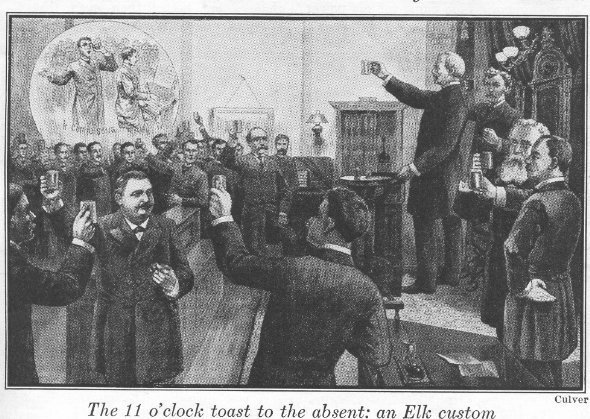
Shaving mugs with paintings of an elk are some of the most common yet attractive of the collectibles. The U.S. flag and a clock with the 11:00 hour are frequently included. Elks consider themselves patriotic and swear to uphold the Constitution of the United States and at each meeting salute the flag. Whenever an Elk's lodge is in session at 11 PM the brothers participate in the "eleven o'clock toast" to absent brothers. Like other fraternal shaving mugs, the most desirable have the lodge number or name inscribed. The flower of the Elks is the forget-me-not. The colors purple and white signify "the love of truth and the highest degree of virtue."


From Elks History: The Original Jolly Corks Toast:


Now is the hour when Elkdom's tower
Is darkened by the shroud of night
And father time on his silver chime
Tolls off each moment's flight.

In Cloistered halls each Elk recalls
His Brothers where'er they be,
And traces their faces to well-known places
In the annals of memory.

Whether they stand on a foreign land
Or lie in an earthen bed,
Whether they be on the boundless sea
With the breakers of death ahead.

Whate'er their plight on this eerie night
Whate'er their fate may be
Where ever they are be it near or far
They are thinking of you and me.

So drink from the fountain of fellowship
To the Brother who clasped your hand
And wrote your worth in the rock of earth
And your faults upon the sand.

TO OUR ABSENT BROTHERS


BPOE Traditions

The BPOE adopted several fraternal traditions similar to the Masonic Fraternity. An altar, decorated with the Holy Bible, is found in the center of every Lodge throughout Elkdom. Old Glory served as the altar's drapery until 1956, when it was given its own distinct place of honor to the right of the altar. An "Exalted Ruler" governs each Elks Lodge as the "Worshipful Master" does in a Masonic Lodge.

Elk Officers wear formal evening dress (tuxedos) during the Initiation Ritual and other ceremonials of the Order. Since 1874, the Exalted Ruler and officers of every Elks Lodge began wearing the new Elks regalia, composed of a purple velvet collar with a small, fawn colored roll and a jewel with an Elk's head with a gilt edge on the collar.

A "Tiler" guards the entrance of every Elks Lodge, and this officer prevents all outsiders from entering a Lodge without proving themselves to be an Elk in good standing.

The BPOE originally utilized a two-degree ritual; the second degree was discontinued in 1890. In fact, the BPOE Grand Lodge has outlawed any side degrees. The solemn and dignified BPOE Initiation Ritual of today is vastly different from the Initiation performed within our Lodges in those early days, with the early minutes of several Lodges, describing the now-solemn ritual in a far different vein.

Early candidates found that a physician's certificate of examination was necessary as a part of the joining process, and the male prospect had to be in top condition to even be considered. Then, once the candidate had met that criteria and was in the Lodge room, he was blindfolded, and instead of dimmed lights and beautiful words, he was subjected to much horseplay. The minutes of the Ashland Lodge No. 384 describe in detail of their candidates wearing shoes with lead soles designed to make the wearer walk as though intoxicated.

The old Ritual Book spells out other trickery, with members agreeing with the Exalted Ruler's declaration that the candidates be "shaved." Once this decision was made, a "City Barber" appeared to the blindfolded candidates whereupon, with a dull file simulating a straight razor, he literally scraped the faces of the men to "shave" them. A few other jokes, all of which were contained in the Ritual Book, described each ordeal in great detail, such as "walking on broken glass," actually egg shells, and it even mentioned how to end the "horseplay" session with real guns, loaded with blanks, being fired off behind the now-weary and very confused new members.

In 1895, the Elks ceased the use of lambskin aprons in their initiatory work, the password was eliminated in 1899, in 1902 the use of a badge was eliminated, with the secret grip falling by the wayside in 1904 and the "Test Oath" was removed in 1911. In 1952, candidates were no longer blindfolded prior to the Initiation. 1995, women were admitted into the Order.


Monday, March 15, 2010

Fraternal Shaving Mugs: Woodmen of the World


Fraternal Mug | W.O.W | H, C. Gillen


From Fraternally Yours by Bernie Lukco:

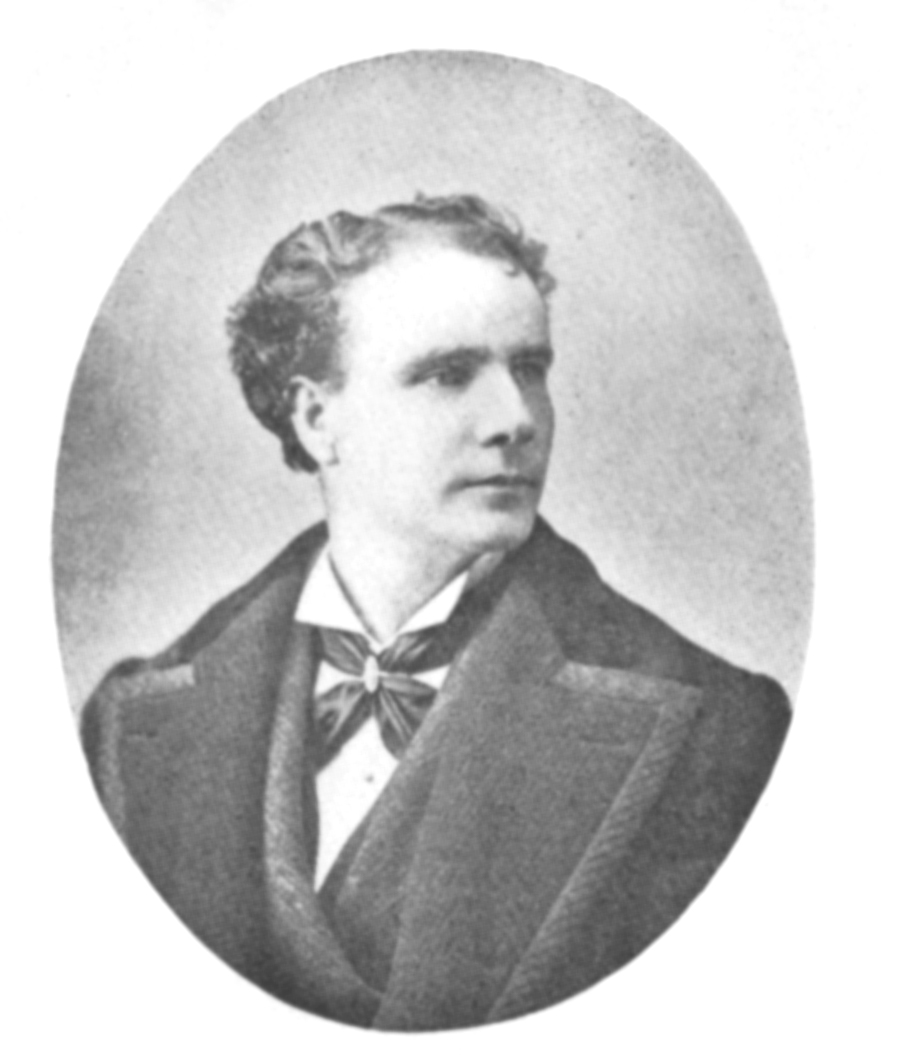
Started as a result of a schism with the Modern Woodmen of America (MWA), the Woodmen of the World (WOW) was started by Joseph Cullen Root of Lyons, Iowa, who coincidentally was the founder of the MWA. Officially organized as a fraternal beneficiary society on June 3, 1890, at the Paxon Hotel, Omaha, Nebraska, Root remained as its Sovereign Commander until the time of his death in 1913 when he was succeeded by Morris Sheppard, U.S. Senator from Texas. It is interesting to note that the WOW continues to operate as a financially sound insurance company.


Fraternal Mug | W.O.W | C.J Wadsworth

The Woodmen had optional degrees of Morning, Noon and Night. The members met in Groves which were governed by the Supreme Nest, and boasted that it was the only order of its kind to place a monument at the grave of every deceased member. Woodmen of the World preserved in form and ceremony implements and teachings drawn from woodcraft. Originally, only white men were eligible for membership but there was no restriction as to religious creed or political conviction. During an elaborate initiation ceremony, hoods were placed over the heads of candidates and a human skull was used to add force to the obligations of the oaths taken. Although horseplay and pranks were a part of the initiation ceremony, the Woodmen took seriously their oaths to "banish poverty from the earth and unite honest men in democratic fellowship." That is probably the reason that their membership included such renowned Americans as William J. Bryan and Robert LaFollette. After three solemn oaths were administered, the ceremony was concluded with the conferring of the "secret word." After that, a song was sung and every participating member went to the altar and grasped the helve of the embedded ax, as a sign to keep silent about the transactions of the camp.

Fraternal Mug | W.O.W | Fay R, Ashby

The WOW were unique for a fraternal organization since they established their own radio station with the call letters, "WOAW" that operated from the roof of their WOW building in Omaha, NE. The first program was broadcast on the evening of April 2, 1923. At that time there were 542,000 active members throughout the United States. This rather large membership accounts for the fact that there are many WOW shaving mugs available. Two scenes are prevalent on WOW shaving mugs. One shows a'leaf and the other a tree stump- Usually the principal emblems are shown - the beetle, wedge, and ax - symbols of the woodmen's craft. A dove is frequently included as a symbol of peace and the Latin words, Dum Tacet Clamat, "While it is silent, it shouts."

Porcelain mug with six polychrome painted fraternal symbols:  Knights of Pythias, Modern Woodmen of the World, one  IOOF Encampment and 3 different Masonic images, including a Knights Templar emblem, a Masonic Keystone, and the square and compass of a Master Mason.  Gilt name is C.H. Johnson. The mug is imprinted Germany on its bottom. (Mug # 2417 in Blake Powell’s Occupational & Fraternal Shaving Mugs of the United States (1978) book.


When Joseph Cullen Root founded Woodmen of the World more than 100 years ago, one of his objectives was to provide a decent burial for all members.

Root made a special effort to honor deceased Woodmen. He created Woodmen Memorial Day, celebrated on June 6 each year, and included the following statement in the Objectives of Woodcraft: "... to give honorable burial to our sacred dead ..."

Early Woodmen certificates provided for a death and a monument benefit. Gravestones were originally furnished to members free of charge and later were offered only to those who purchased a $100 rider to their certificates.

However, during the 1920s the Society stopped providing stone markers to members when the cost of gravestones increased and cemeteries began prohibiting above-ground markers for maintenance reasons. The monument rider was discontinued and converted to an extra $100 of insurance protection, but for many years after that, members and lodges arranged for markers and monuments on their own.

Woodmen gravestones vary greatly in size and shape. Some resemble a tree stump, others a stack of cut wood. There are elaborate hand-carved monuments, simple stone markers and stake-type markers driven into the ground.


Friday, February 12, 2010

Fraternal Shaving Mug: Concatenated Order of Hoo-Hoo


Porcelain with polychrome painted Egyptian cat, whose tail is curled into the number 9, this being an all important number in the Order of the Hoo-Hoos, whose beliefs are grounded in the fighting of superstition and conventionalism. The Hoo-Hoos were founded in 1892 in Arkansas, and were a selective and small order, although nationally based. All of their functions, initiation fees and meeting dates were based around the number 9. This mug comes with a document on the order, and is marked Limoges, France. Minor gilt wear, otherwise excellent condition. Price Realized: $1,495.00. From Cowan's


The International Concatenated Order of Hoo-Hoo, Incorporated is a fraternal and service organization whose members are involved in the forests products industry. Hoo-Hoo has members in the United States, Canada, Australia, New Zealand, Malaysia and South Africa. It was founded in 1892 in Gurdon, Arkansas, USA by five business travelers who were returning from a meeting of the Arkansas Yellow Pine Manufacturer's Association, and had to wait several hours for their connecting train. They were joined by a local businessman. The first name suggested for the new organization was Ancient Order of Camp Followers, but the name Concatenated Order of Hoo-Hoo was selected instead.

The founders wanted the organization to be unconventional and unregimented. Its one aim would be to foster the health, happiness, and long life of its members.[1] In a spirit of fun, names for some of the officers were inspired by Lewis Carroll's The Hunting of the Snark. The chief executive officer of Hoo-Hoo is the Snark of the Universe (formerly the Grand Snark of the Universe). The Board of Directors includes the Chairman, Vice-President, Secretary-Treasurer, the Seer of the House of Ancients and the Supreme Nines. The Supreme Nines include the Supreme Hoo-Hoo, Senior Hoo-Hoo, Junior Hoo-Hoo, Scrivenoter, Bojum, Jabberwock, Custocatian, Arcanoper and Gurdon. The Hoo-Hoo emblem is a black cat with its tail curled into the shape of a figure nine. The order has a traditional chant that is called at the beginning and end of each meeting "Hoo-hoo, made a Poo-poo!" - Wikipedia: Concatenated Order of Hoo-Hoo


 Logo of the Concatenated Order of Hoo-Hoo, 
featuring the black cat with its tail curled in a figure nine.


  • January 1892: It was decided to call the new order the "Concatenated Order of Hoo-Hoo", and not the "Ancient Order of Camp Followers" as one founding father suggested.   
  • September 1892: The first Hoo-Hoo convention was held in St. Louis, Missouri. The total membership of the order was 167.
  • September 1906: The first membership card was issued. Membership fee was increased from 99 cents to $1.65 (99 cents for dues and 66 cents for subscription to the Bulletin).
  • January 1909: The first official Hoo-Hoo flag was exhibited during a special concatenation in New Orleans, Louisian
  • July 1921: The first establishment of an independent club when the Atlanta Hoo-Hoo Club No. 1 (now the Dick Wilson/Atlanta Hoo-Hoo Club No. 1) adopted a constitution and bylaws and voted to meet monthly.
  • March 1924: First club outside the United Stated was established in Winnipeg, Manitoba, Canada - Winnipeg Hoo-Hoo Club No. 24.
  • May 1924: Detroit Hoo-Hoo Club No. 28 conducted the largest concatenation in Hoo-Hoo's history with 260 kitten
  • 1962: First club in Australia formed - Adelaide Hoo-Hoo Club No. 212.


    In Hotel Hall in Gurdon, the men set up the basic tenets of the order. Hoo-Hoo was to be an organization comprising men with high ideals, and the order’s motto became “Health, Happiness, and Long Life.” The group (led by Johnson) decided that the board of directors would be called the “Supreme Nine.” The names of the directors were: Snark of the Universe (president), Bojum (chaplain), Scrivenoter (secretary), Gurdon (sergeant-at-arms), Senior Hoo-Hoo, Junior Hoo-Hoo, Custocacian, Arcanoper, and Bandersnatch (later changed to Jabberwock). Some of these names were derived from Lewis Carroll’s Hunting of the Snark, which one of the founders had recently read. The name “Hoo-Hoo” also had a unique origin. In Kansas City, about a month before the founding of the order, Johnson had used the term “hoo-hoo” to refer to an unusual tuft of hair on the head of Charles McCarer. McCarer became the first Snark of the Universe and was given membership number one.
    Consistent with their unconventionality, the group chose as its mascot a black cat with its tail curved into the number nine. Originally, membership in Hoo-Hoo was to be limited to 9,999 members. As the order increased in popularity, this number was changed to 99,999. Meetings were held on the ninth day of the ninth month at nine minutes after the ninth hour. Annual dues were $9.99, and the initiation fee was $0.99.

    After its humble beginnings in Gurdon, the Concatenated Order of Hoo-Hoo grew tremendously. The first club established outside the United States was founded in Canada in 1924, and other groups sprouted up in places as far away as Australia. Though the Hoo-Hoo experienced a slump from 1929 to 1938, when membership dropped to around 700, the order recovered, and membership began to rise again.

    Two U.S. presidents have had membership in Hoo-Hoo. Theodore Roosevelt was given the reserved membership number 999 for his work promoting the importance of forests. Warren G. Harding, membership number 14,945, was “concatenated” in 1905.
    - Encyclopedia of Arkansas History


    This delightful folk rag, which is available on the "Lester Levy" website, was written in honor of "The Concatenated Order of Hoo-Hoo" (the cover has a replica of their official symbol). According to its website TCOHH is, "the oldest industrial Fraternal Organization in existence in the USA" (being founded in Jan. 1892 as a "public relations department of the lumber industry"). From Silent Porn Star

     The only other Hoo Hoo mug I have ever seen.
    Source: Fraternally, Yours by Bernie Lucko