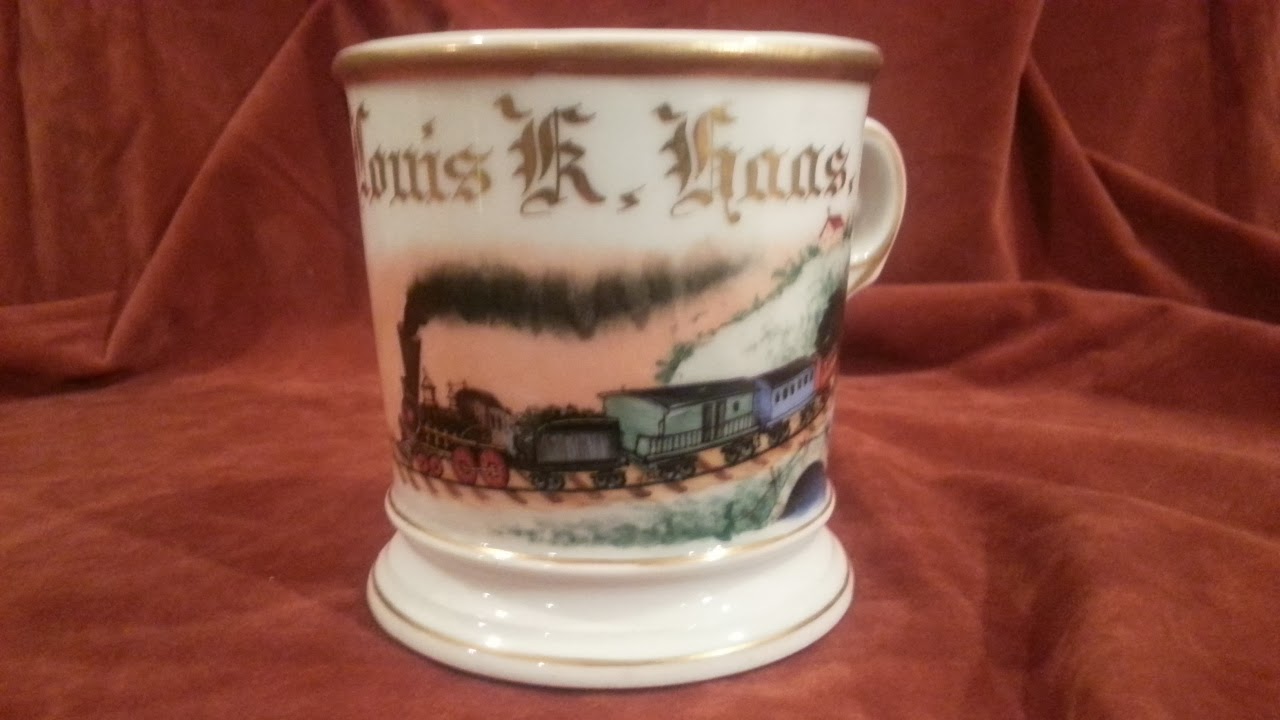
The following text and noted images are from the document,
Railroad Brotherhoods History and Their Fraternal Shaving Mugs by Joseph Albanese (courtesy of the JLT Archive). It is presented here for educational purposes only in order to preserve a valuable document of Shaving Mug History. All other images are from the JLT Collection.
RAILROAD BROTHERHOODS
"Along with many other pioneering labor organizations in the
nineteenth-century America, organizations of railroad workers took the
name "brotherhoods" in token of their partly fraternal purposes. The
most powerful of the railroad brotherhoods was those formed in the
operating trades-those directly involved with moving trains. These
included the Brotherhood of Locomotive Engineers (founded in 1863),
the Order of Railway Conductors (1868), the Brotherhood of
Locomotive Firemen (1873), and Brotherhood of Railroad Trainmen
(founded in 1883 as the Brotherhood of Railroad Brakemen).
Sometimes grouped with "the Big Four" was the Switchmen's Union
(1894), "who were responsible for making up trains and for controlling
the track switches within a yard. Numerous other unions were founded
to represent non-operating railroad employees such as the trackmen
(1887), railway clerks (1899), and sleeping car porters (1925). Though
the operating brotherhoods represented less than one-fifth of all
railroad employees, they dominated the history of organized labor in
the railroad industry.
Although rail transportation has declined, the fraternal shaving mugs of
these brotherhoods represent a period of our history when railroads
were a central part of our daily lives."
 |
| Photo by J. Albanese |
 |
| JLT Collection |
 |
| JLT Collection |
 |
| JLT Collection |
BROTHERHOOD OF LOCOMOTIVE FIREMEN
"Lodge No. 1 of the Brotherhood of Locomotive Firemen was organized by Joshua Leach and 10 Erie
firemen at Port Jarvis, N.Y., in 1873. The following year, delegates from 12 lodges met and formed the
"BLF Insurance Association" to provide sickness and funeral benefits for locomotive firemen. In 1906,
BLF changed its name to Brotherhood of Locomotive Firemen and Enginemen and joined in bargaining
with the three other major railway unions. In 1919, with 116,990 members the BLF&E led the fight for
an eight-hour day for rail workers, and in 1923 pressed successfully for passage of the Railway Labor Act
Historically, before a railroad worker would become a fireman, he would have to "pay his dues" by
completing various jobs, including: Engine wiper, empties the clinker pit and perform other types of
drudgery. If the railroad worker performed these tasks at a satisfactory level, he will eventually be
promoted and placed on the "extra fireman" list, and eventually can move up to become a regular
fireman. The fireman's primary job was to shovel coal into the firebox and ensure that the boiler
maintained sufficient steam pressure. The locomotive Fireman also served as a "copilot to the
engineer". He was responsible for knowing the signals, curves and grade changes to anticipate the
amount of steam needed."
 |
| Photo by J. Albanese |
BROTHERHOOD OF RAILWAY CLERKS
"Railway clerks organized into a union in 1899, and became the Brotherhood of Railway Clerks in 1904.
The clerks were affiliated with the American Federation of Labor from 1900-1901, and then after 1908.
The BRC was a weak railway union with a small (around 5,000 people) membership in its early years of
existence. That situation changed during the First World War, when the federal government took
control of the nation's railway system, and put it under the management of the United States Railroad
Administration (USRA) which ran the nation's railroads from January 1918 through March 1920. The
USRA recognized the rights of railway employees to join unions, and raised the clerks' salaries."
 |
| Photo by J. Albanese |
 |
| JLT Collection |
 |
| JLT Collection |
 |
| JLT Collection |
ORDER OF RAILWAY CONDUCTORS AND BRAKEMEN
"In The spring of 1868 TJ. "Tommie" Wright and a small band of conductors formed the first conductors'
union, known as "Division Number 1 Conductors' Brotherhood" at Amboy, Illinois. Word spread quickly,
and by November 1868, the union's first convention was held in Columbus, Ohio, where conductors
from the U.S. and Canada adopted the name "Order of Railway Conductors of America".ln 1885, the
ORC directed its leaders to aid in the negotiating agreements with carriers, a revolutionary idea for the
time. In 1890, the ORC adopted a strike clause and began a militant policy of fighting for the welfare of
the conductors. In 1942, the Order of Sleeping Car Conductors amalgamated with ORC, and in 1954 the
organization was renamed the order of Railroad Conductors and Brakemen to reflect its diverse
membership.
Railroad conductors coordinate the efforts of all crew members involved in freight and passenger rail
transport. They review schedules of arrivals and departures for passenger trains and freight shipments.
They are responsible for ensuring the safety of each car and its passengers as well as collecting fares and
tickets. Prior to departure they worked with the engineer to ensure the smoothest trip possible."
 |
| Photo by J. Albanese |
SWITCHMEN'S UNION OF NORTH AMERICA
"In 1870, switchmen employed on railroads in the Chicago area worked 12 hours a day, seven days a
week, for $50.00. Helpless in bargaining with their employers individually, they banded together in
August of that year to form the Switchmen's Association. In 1886, switchmen met in Chicago and formed the Switchmen's Mutual Aid Association, but a lockout
on the Chicago Northwestern Railroad and a disastrous strike in 1888 on the Chicago, Burlington and
Quincy Railroad ended the Association in July 1894. Later that year, however, a meeting in Kansas City,
MO., led to the establishment of the Switchmen's Union of North America.
A switchman is the railroad worker responsible for controlling the track switches within a yard."