Tuesday, October 22, 2013

Railroad Brotherhoods History and Their Fraternal Shaving Mugs by Joseph Albanese


The following text and noted images are from the document, Railroad Brotherhoods History and Their Fraternal Shaving Mugs by Joseph Albanese (courtesy of the JLT Archive). It is presented here for educational purposes only in order to preserve a valuable document of Shaving Mug History. All other images are from the JLT Collection.


RAILROAD BROTHERHOODS 

"Along with many other pioneering labor organizations in the nineteenth-century America, organizations of railroad workers took the name "brotherhoods" in token of their partly fraternal purposes. The most powerful of the railroad brotherhoods was those formed in the operating trades-those directly involved with moving trains. These included the Brotherhood of Locomotive Engineers (founded in 1863), the Order of Railway Conductors (1868), the Brotherhood of Locomotive Firemen (1873), and Brotherhood of Railroad Trainmen (founded in 1883 as the Brotherhood of Railroad Brakemen). Sometimes grouped with "the Big Four" was the Switchmen's Union (1894), "who were responsible for making up trains and for controlling the track switches within a yard. Numerous other unions were founded to represent non-operating railroad employees such as the trackmen (1887), railway clerks (1899), and sleeping car porters (1925). Though the operating brotherhoods represented less than one-fifth of all railroad employees, they dominated the history of organized labor in the railroad industry.

Although rail transportation has declined, the fraternal shaving mugs of these brotherhoods represent a period of our history when railroads were a central part of our daily lives."


Photo by J. Albanese

JLT Collection

JLT Collection

JLT Collection


BROTHERHOOD OF LOCOMOTIVE FIREMEN 

"Lodge No. 1 of the Brotherhood of Locomotive Firemen was organized by Joshua Leach and 10 Erie firemen at Port Jarvis, N.Y., in 1873. The following year, delegates from 12 lodges met and formed the "BLF Insurance Association" to provide sickness and funeral benefits for locomotive firemen. In 1906, BLF changed its name to Brotherhood of Locomotive Firemen and Enginemen and joined in bargaining with the three other major railway unions. In 1919, with 116,990 members the BLF&E led the fight for an eight-hour day for rail workers, and in 1923 pressed successfully for passage of the Railway Labor Act Historically, before a railroad worker would become a fireman, he would have to "pay his dues" by completing various jobs, including: Engine wiper, empties the clinker pit and perform other types of drudgery. If the railroad worker performed these tasks at a satisfactory level, he will eventually be promoted and placed on the "extra fireman" list, and eventually can move up to become a regular fireman. The fireman's primary job was to shovel coal into the firebox and ensure that the boiler maintained sufficient steam pressure. The locomotive Fireman also served as a "copilot to the engineer". He was responsible for knowing the signals, curves and grade changes to anticipate the amount of steam needed."


Photo by J. Albanese


BROTHERHOOD OF RAILWAY CLERKS 

"Railway clerks organized into a union in 1899, and became the Brotherhood of Railway Clerks in 1904. The clerks were affiliated with the American Federation of Labor from 1900-1901, and then after 1908. The BRC was a weak railway union with a small (around 5,000 people) membership in its early years of existence. That situation changed during the First World War, when the federal government took control of the nation's railway system, and put it under the management of the United States Railroad Administration (USRA) which ran the nation's railroads from January 1918 through March 1920. The USRA recognized the rights of railway employees to join unions, and raised the clerks' salaries."


Photo by J. Albanese

JLT Collection

JLT Collection

JLT Collection


ORDER OF RAILWAY CONDUCTORS AND BRAKEMEN 

"In The spring of 1868 TJ. "Tommie" Wright and a small band of conductors formed the first conductors' union, known as "Division Number 1 Conductors' Brotherhood" at Amboy, Illinois. Word spread quickly, and by November 1868, the union's first convention was held in Columbus, Ohio, where conductors from the U.S. and Canada adopted the name "Order of Railway Conductors of America".ln 1885, the ORC directed its leaders to aid in the negotiating agreements with carriers, a revolutionary idea for the time. In 1890, the ORC adopted a strike clause and began a militant policy of fighting for the welfare of the conductors. In 1942, the Order of Sleeping Car Conductors amalgamated with ORC, and in 1954 the organization was renamed the order of Railroad Conductors and Brakemen to reflect its diverse membership. Railroad conductors coordinate the efforts of all crew members involved in freight and passenger rail transport. They review schedules of arrivals and departures for passenger trains and freight shipments. They are responsible for ensuring the safety of each car and its passengers as well as collecting fares and tickets. Prior to departure they worked with the engineer to ensure the smoothest trip possible."


Photo by J. Albanese

source


SWITCHMEN'S UNION OF NORTH AMERICA 

"In 1870, switchmen employed on railroads in the Chicago area worked 12 hours a day, seven days a week, for $50.00. Helpless in bargaining with their employers individually, they banded together in August of that year to form the Switchmen's Association. In 1886, switchmen met in Chicago and formed the Switchmen's Mutual Aid Association, but a lockout on the Chicago Northwestern Railroad and a disastrous strike in 1888 on the Chicago, Burlington and Quincy Railroad ended the Association in July 1894. Later that year, however, a meeting in Kansas City, MO., led to the establishment of the Switchmen's Union of North America. A switchman is the railroad worker responsible for controlling the track switches within a yard."


Saturday, October 19, 2013

Fraternal Shaving Mugs: Amalgamated Association of Street and Electrical Railway Employees of America


source

NSMCA


From Fraternally, Yours by Bernie Lucko:

"This was a relatively small but diverse labor organization. In 1944, there were 125,000 members in 435 locals of this union that was headquartered in Detroit, Michigan. By that time, the union included motormen, conductors, guards, brakemen, trolleymen, bus and coach operators, garage men and all men operating cars and trams, all gatemen, watchmen and Wardens, all employees of the car houses and pit department, all collectors, janitors, watchmen, yard crews, elevator men, porters, clerks, trackmen and laborers.  One has to wonder why there are not more mugs depicting this trade with so many jobs included within the union. In addition, individuals who held minor position such as starter, dispatcher, inspector, timekeeper, streetmen or barn shop and track foremen, "working with their fellow workers and not having the power of discipline in the way of hiring, suspending or discharging employees," (that is, non-supervisors) could join the union. 
The union was organized in 1892 in Indianapolis, Indiana and initially represented those working with horse drawn and electric trolley and interurban rail lines. These individuals primarily moved passengers, not freight, and were not directly connected with the interstate railroads that crossed the country during this period of industrial growth. The mug depicts an electric street car with the letters "AA of S & ERE of A" above it."


source

From The Historical Society of Pennsylvania:

The Amalgamated Association of Street and Electric Railway Employees of America (Amalgamated) formed in 1892. Arguing for increased benefits and compensation, Amalgamated organized successful, but occasionally violent, strikes of Philadelphia Rapid Transit Company workers in 1909 and 1910. The union continues today as the Amalgamated Transit Union (ATU).


source


Friday, March 26, 2010

Fraternal Shaving Mugs: Benevolent Protective Order of the Elks | BPOE


From Fraternally Yours by Bernie Lukco:

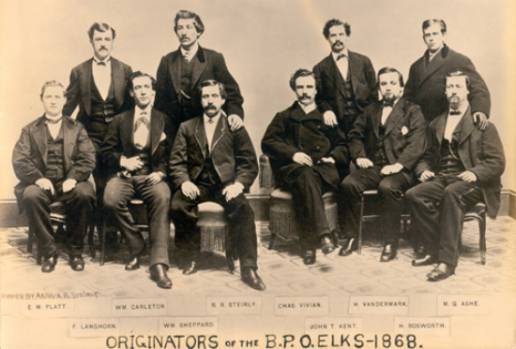
A New York State law that closed saloons and theaters on Sunday was directly responsible for the establishment of the Benevolent and Protective Order of the Elks (BPOE) in 1866. A group of booze-loving actors in New York City found a way to sidestep the new Sabbath "blue" law by renting a room on the Bowery where they could enjoy Sunday drinking.


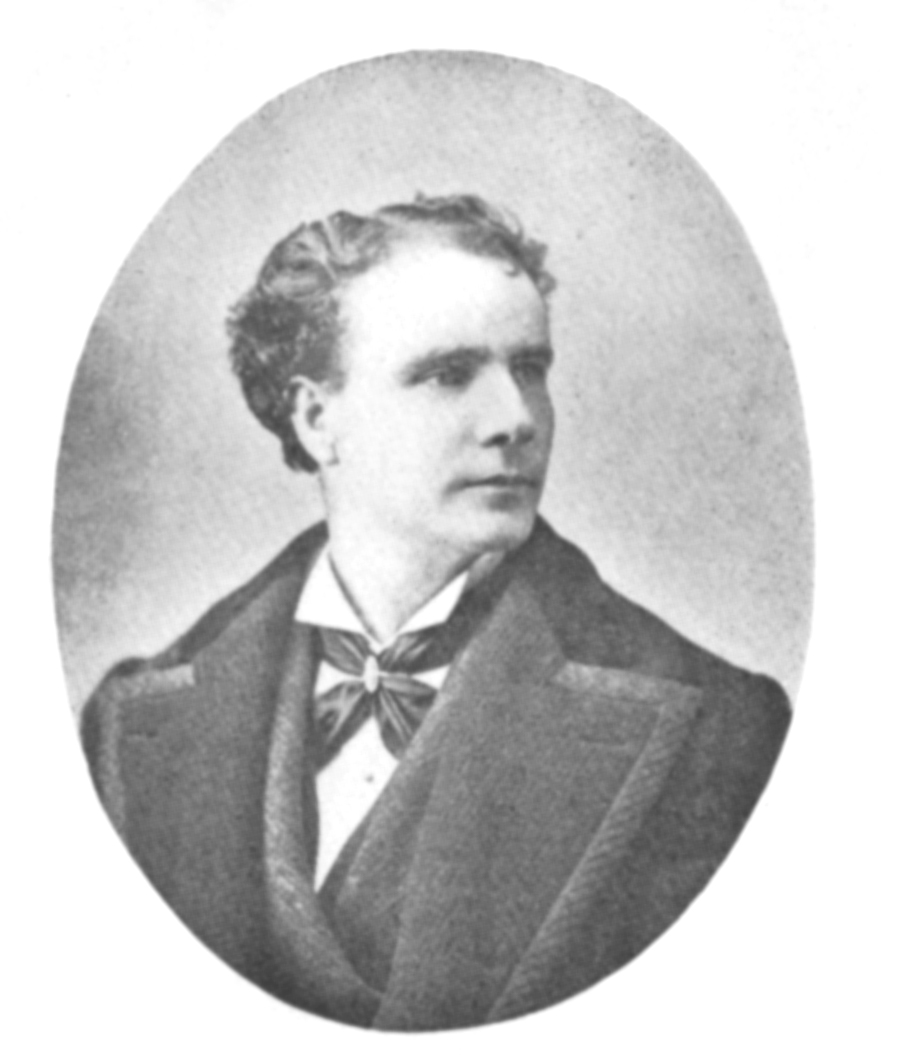
 Charles Vivian [source]

They called themselves the Jolly Corks based on a "ritual" established by an actor Charles Vivian, who also became known as the Imperial Cork. A candidate would be brought in, and everyone was given a cork. The Imperial Cork would announce that the last one who placed a cork in front of his place would be required to buy drinks for everyone. The signal was given, and there was a mad scramble. The candidate picked up his hurriedly and found that he was the only one who had lifted his cork -- thus the last one. Such were the side-splitting pranks of the Jolly Corks. Members were required always to carry a cork under penalty of buying a drink.


In time, members decided that a permanent organization with a constitution was needed. A committee was formed to draft the constitution. A meeting was planned and members went into P.T. Barnum's Museum to see if a name might suggest itself. A fine moose head, which members mistook for that of an elk, and a description of the elk in Buffon's Natural History influenced the decision. The animal from which the Order took its name was chosen because a number of its attributes were deemed typical of those to be cultivated by members of the fraternity. The elk is distinctively an American animal. It habitually lives in herds. The largest of our native quadrupeds, it is yet fleet of foot and graceful in movement. It is quick and keen of perception; and while it is usually gentle, it is strong and valiant in defense of its own.


The BPOE considers Feb. 16, 1868, to be its date of founding. It states its own purposes as the practice of the four cardinal virtues of charity, justice, brotherly love, and fidelity; the promotion of the welfare and happiness of its members; the fostering of patriotism; and the cultivation of good fellowship. The BPOE is organized into a grand lodge and subordinate lodges. Lodges may be established only in United States cities that have not less than 5,000 inhabitants. By 1924, there were 839,422 members. Like many other organizations, the numbers diminished during the economic depression of the 1930's.


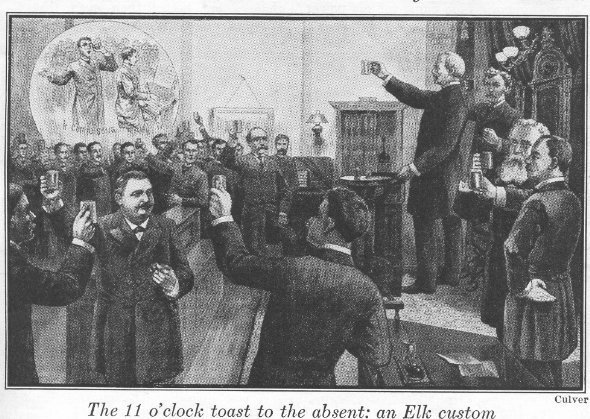
Shaving mugs with paintings of an elk are some of the most common yet attractive of the collectibles. The U.S. flag and a clock with the 11:00 hour are frequently included. Elks consider themselves patriotic and swear to uphold the Constitution of the United States and at each meeting salute the flag. Whenever an Elk's lodge is in session at 11 PM the brothers participate in the "eleven o'clock toast" to absent brothers. Like other fraternal shaving mugs, the most desirable have the lodge number or name inscribed. The flower of the Elks is the forget-me-not. The colors purple and white signify "the love of truth and the highest degree of virtue."


From Elks History: The Original Jolly Corks Toast:


Now is the hour when Elkdom's tower
Is darkened by the shroud of night
And father time on his silver chime
Tolls off each moment's flight.

In Cloistered halls each Elk recalls
His Brothers where'er they be,
And traces their faces to well-known places
In the annals of memory.

Whether they stand on a foreign land
Or lie in an earthen bed,
Whether they be on the boundless sea
With the breakers of death ahead.

Whate'er their plight on this eerie night
Whate'er their fate may be
Where ever they are be it near or far
They are thinking of you and me.

So drink from the fountain of fellowship
To the Brother who clasped your hand
And wrote your worth in the rock of earth
And your faults upon the sand.

TO OUR ABSENT BROTHERS


BPOE Traditions

The BPOE adopted several fraternal traditions similar to the Masonic Fraternity. An altar, decorated with the Holy Bible, is found in the center of every Lodge throughout Elkdom. Old Glory served as the altar's drapery until 1956, when it was given its own distinct place of honor to the right of the altar. An "Exalted Ruler" governs each Elks Lodge as the "Worshipful Master" does in a Masonic Lodge.

Elk Officers wear formal evening dress (tuxedos) during the Initiation Ritual and other ceremonials of the Order. Since 1874, the Exalted Ruler and officers of every Elks Lodge began wearing the new Elks regalia, composed of a purple velvet collar with a small, fawn colored roll and a jewel with an Elk's head with a gilt edge on the collar.

A "Tiler" guards the entrance of every Elks Lodge, and this officer prevents all outsiders from entering a Lodge without proving themselves to be an Elk in good standing.

The BPOE originally utilized a two-degree ritual; the second degree was discontinued in 1890. In fact, the BPOE Grand Lodge has outlawed any side degrees. The solemn and dignified BPOE Initiation Ritual of today is vastly different from the Initiation performed within our Lodges in those early days, with the early minutes of several Lodges, describing the now-solemn ritual in a far different vein.

Early candidates found that a physician's certificate of examination was necessary as a part of the joining process, and the male prospect had to be in top condition to even be considered. Then, once the candidate had met that criteria and was in the Lodge room, he was blindfolded, and instead of dimmed lights and beautiful words, he was subjected to much horseplay. The minutes of the Ashland Lodge No. 384 describe in detail of their candidates wearing shoes with lead soles designed to make the wearer walk as though intoxicated.

The old Ritual Book spells out other trickery, with members agreeing with the Exalted Ruler's declaration that the candidates be "shaved." Once this decision was made, a "City Barber" appeared to the blindfolded candidates whereupon, with a dull file simulating a straight razor, he literally scraped the faces of the men to "shave" them. A few other jokes, all of which were contained in the Ritual Book, described each ordeal in great detail, such as "walking on broken glass," actually egg shells, and it even mentioned how to end the "horseplay" session with real guns, loaded with blanks, being fired off behind the now-weary and very confused new members.

In 1895, the Elks ceased the use of lambskin aprons in their initiatory work, the password was eliminated in 1899, in 1902 the use of a badge was eliminated, with the secret grip falling by the wayside in 1904 and the "Test Oath" was removed in 1911. In 1952, candidates were no longer blindfolded prior to the Initiation. 1995, women were admitted into the Order.


Monday, March 15, 2010

Fraternal Shaving Mugs: Woodmen of the World


Fraternal Mug | W.O.W | H, C. Gillen


From Fraternally Yours by Bernie Lukco:

Started as a result of a schism with the Modern Woodmen of America (MWA), the Woodmen of the World (WOW) was started by Joseph Cullen Root of Lyons, Iowa, who coincidentally was the founder of the MWA. Officially organized as a fraternal beneficiary society on June 3, 1890, at the Paxon Hotel, Omaha, Nebraska, Root remained as its Sovereign Commander until the time of his death in 1913 when he was succeeded by Morris Sheppard, U.S. Senator from Texas. It is interesting to note that the WOW continues to operate as a financially sound insurance company.


Fraternal Mug | W.O.W | C.J Wadsworth

The Woodmen had optional degrees of Morning, Noon and Night. The members met in Groves which were governed by the Supreme Nest, and boasted that it was the only order of its kind to place a monument at the grave of every deceased member. Woodmen of the World preserved in form and ceremony implements and teachings drawn from woodcraft. Originally, only white men were eligible for membership but there was no restriction as to religious creed or political conviction. During an elaborate initiation ceremony, hoods were placed over the heads of candidates and a human skull was used to add force to the obligations of the oaths taken. Although horseplay and pranks were a part of the initiation ceremony, the Woodmen took seriously their oaths to "banish poverty from the earth and unite honest men in democratic fellowship." That is probably the reason that their membership included such renowned Americans as William J. Bryan and Robert LaFollette. After three solemn oaths were administered, the ceremony was concluded with the conferring of the "secret word." After that, a song was sung and every participating member went to the altar and grasped the helve of the embedded ax, as a sign to keep silent about the transactions of the camp.

Fraternal Mug | W.O.W | Fay R, Ashby

The WOW were unique for a fraternal organization since they established their own radio station with the call letters, "WOAW" that operated from the roof of their WOW building in Omaha, NE. The first program was broadcast on the evening of April 2, 1923. At that time there were 542,000 active members throughout the United States. This rather large membership accounts for the fact that there are many WOW shaving mugs available. Two scenes are prevalent on WOW shaving mugs. One shows a'leaf and the other a tree stump- Usually the principal emblems are shown - the beetle, wedge, and ax - symbols of the woodmen's craft. A dove is frequently included as a symbol of peace and the Latin words, Dum Tacet Clamat, "While it is silent, it shouts."

Porcelain mug with six polychrome painted fraternal symbols:  Knights of Pythias, Modern Woodmen of the World, one  IOOF Encampment and 3 different Masonic images, including a Knights Templar emblem, a Masonic Keystone, and the square and compass of a Master Mason.  Gilt name is C.H. Johnson. The mug is imprinted Germany on its bottom. (Mug # 2417 in Blake Powell’s Occupational & Fraternal Shaving Mugs of the United States (1978) book.


When Joseph Cullen Root founded Woodmen of the World more than 100 years ago, one of his objectives was to provide a decent burial for all members.

Root made a special effort to honor deceased Woodmen. He created Woodmen Memorial Day, celebrated on June 6 each year, and included the following statement in the Objectives of Woodcraft: "... to give honorable burial to our sacred dead ..."

Early Woodmen certificates provided for a death and a monument benefit. Gravestones were originally furnished to members free of charge and later were offered only to those who purchased a $100 rider to their certificates.

However, during the 1920s the Society stopped providing stone markers to members when the cost of gravestones increased and cemeteries began prohibiting above-ground markers for maintenance reasons. The monument rider was discontinued and converted to an extra $100 of insurance protection, but for many years after that, members and lodges arranged for markers and monuments on their own.

Woodmen gravestones vary greatly in size and shape. Some resemble a tree stump, others a stack of cut wood. There are elaborate hand-carved monuments, simple stone markers and stake-type markers driven into the ground.


Thursday, February 25, 2010

Record Breakers: The Aeronaut and The Ambulance Mugs


[ source ] 
The record for an occupational mug was broken twice when this aeronaut mug flew to $45,000.


W. Yoder Auction Sets World Record For Shaving Mug Collection - March 25th, 2008

Wautoma, Wisconsin - It was standing room only at the Deforest Comfort Inn Convention Center where Wayne Yoder conducted a sale on February 9. On the auction block were the complete occupational shaving mugs, stoneware and art pottery collections of Jeffery Skou. Many states were represented with attendees from Ohio, Florida, Indiana, Tennessee, Iowa, New York and Missouri, not to mention Wisconsin. Many out of state people were also bidding over the phone.

It did not take long for an ambulance occupational mug, which is one of only two known, to set a new world record price of $29,000, beating the previous auction record of $22,500. Then, just an hour and a half later, that new occupational mug record was broken when a one-of-a-kind aeronaut mug flew to $45,000, driven by some competitive bidding.


[ source ] 
It did not take long for occupational mug records to fall when this ambulance mug came up. One of only two known, and in excellent condition, it sold for $29,000, setting a new record.


Wednesday, February 17, 2010

The Barber Shop at Shelburne Village, Vermont


All of these images are from a Picasa Photoset by Emma.


Occupational Mug | Farmer?

Occupational Mug | Printer

Occupational Mug | Liveryman

Occupational Mug | Blacksmith

Occupational Mug | Railroad

Occupational Mug | Photographer

Occupational Mug | Mortician

Occupational Mug | Telephone Operator

Occupational Mug | Musician | T. N. Girjalva

All of these images are from a Picasa Photoset by Emma.

Tuesday, February 16, 2010

Photographic Mug & Female Barbers | Samson & Delilah


A lady barber's occupational shaving mug, porcelain with a slightly erotic photographic transfer of a scantily clad female barber preparing to shave a customer, teasingly leaning forward, much to the excitement of the man. Gilt name along foot Magg E. Clifton. The scene on mug was first used in a comic stereoview card. From Prices4antiques.com


Barbers in Seattle joined two gender-separate unions.
These women belonged to the Lady Barbers Union
University of Washington, Special Collections Library


 Wellcome Library, London

Men being shaved and having their hair cut, styled and crimped by various male and female barbers.

 Coloured Etching | 1787
 Wellcome Library, London

A female barber shaving a man; a male assistant standing on the right holds a "puff lather" bowl. [ Note the Samson and Delilah in the background. ]


Copperplate Engraving by Matham | Samson and Delilah | c. 1613


Delilah was approached by the lords of the Philistines, to discover the secret of Samson's strength, "and we will give thee every one of us eleven hundred pieces of silver". Three times she asked Samson for the secret of his strength, and three times he gave her a false answer. First he told her "If they bind me with seven green withes that were never dried, then shall I be weak, and be as another man.". Then he told her "If they bind me fast with new ropes that never were occupied, then shall I be weak, and be as another man.". A third time he told her "If thou weavest the seven locks of my head with the web". On the fourth occasion he gave her the true reason: that he did not cut his hair in fulfillment of a vow to God; and Delilah, when Samson was asleep on her knees, called up her man to shave off the seven locks from his head, then betrayed him to his enemies: "the Philistines took him, and put out his eyes, and brought him down to Gaza, and bound him with fetters of brass; and he did grind in the prison house".

Some consider one of the false secrets given by Samson, that his strength would leave him if his hair were woven into a cloth, to be reminiscent of arcane woman's magic of the art of weaving that is also inherent in the myths of Penelope, Circe, Arachne. 
From Wikipedia: Delilah

The Female Barber | Mezzotint by J. Dixon
 Wellcome Library, London